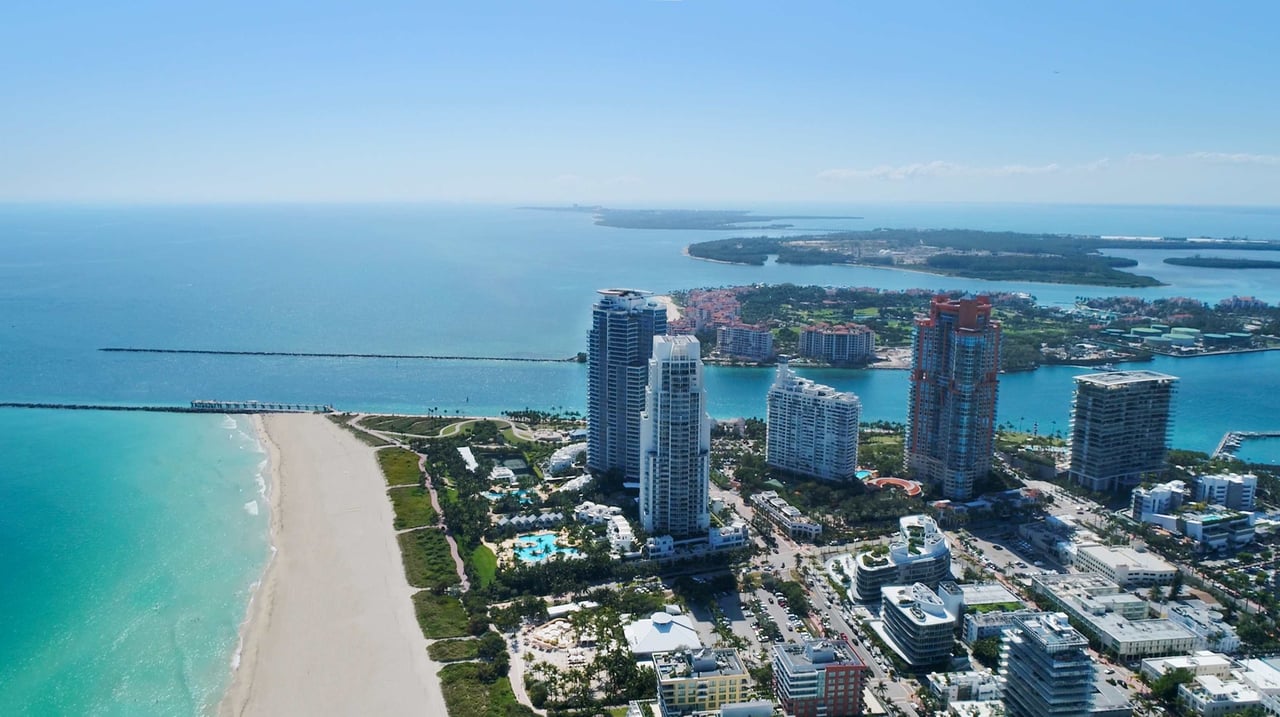
Stand on the promenade at South Pointe Park around dusk, dog leash in hand or coffee in the other, and you'll watch the same thing happen every night. A cargo ship or a cruise liner slides through Government Cut toward the port, and right on cue, the tall striped tower at the park's entrance starts cycling through color. Most people who live here have decided, without ever checking, that this is a lighthouse. It has the shape for it. It sits at the mouth of a shipping channel. It lights up at night. Case closed.
Except it isn't a lighthouse, and the artist who built it told the city that in writing before it went up.
The tower has a name, and the name is the joke
The piece is called obstinate lighthouse. Tobias Rehberger, a German artist based in Frankfurt, won the commission from Miami Beach's Art in Public Places program in December 2010, and the finished work was unveiled the following year as the city's 18th public art project. It stands 55 feet tall, built from 19 staggered aluminum cylinders in frosted glass, crowned with a ring of LED lights that shift color through the night. When it was unveiled, Miami New Times covered the reveal and described the striped stack as one that "closely resembles a stack of Oreo cookies organically built by a three-year-old," which is either the least reverent or most accurate description of a public sculpture in Miami Beach's collection.
Rehberger built the piece as, in his own words, "a modern, playful interpretation of a beacon." The word doing the work there is interpretation. In the artist statement filed with the city, he was explicit that the lights are not navigational. Nobody piloting a container ship or a cruise liner through Government Cut is meant to use those colors to find their way. The lighthouse form is a costume the piece wears, not a job it does. Its actual function, per Rehberger's own statement, is to greet everyone entering the city by water with something cheerful, a welcome mat built at the scale of a five-story building.
That reframing changes what you're looking at every time you pass it walking the bark park loop or cutting through to the beach. It's not maritime infrastructure. It's a 55-foot piece of civic small talk aimed at Fisher Island, the cruise terminal, and every sailboat coming back from a Biscayne Bay afternoon.
It has a second half, and almost nobody connects the two
Here's the part that gets missed even by people who've lived within four blocks of the park for years. Rehberger didn't stop at the lighthouse. Three years later, in 2014, he installed a second piece at the entrance to South Pointe Pier itself, a few hundred feet south along the same walking path. It's an archway, painted in the same bright, staggered palette as the tower, topped with a sculptural shape the artist called a speech bubble.
The artist's own description of the gate makes the connection explicit: he designed it to "have the pier introduce itself to its visitors," using the speech bubble motif that recurs across his body of work as a way of making inanimate structures seem to talk. When you walk from the lighthouse to the gate, or the reverse, you're not passing two unrelated sculptures that happen to share a park. You're walking the length of one sentence. The lighthouse greets you from a distance. The gate, a short walk later, finishes the thought at the point where land actually ends and the 450-foot pier begins.
Almost every account of South Pointe Park treats these as two separate stops on a stroll, if the gate gets mentioned at all. Rehberger built them to read as a pair, a visual conversation between the piece that welcomes boats from the water and the piece that welcomes walkers onto the pier. Knowing that changes the two-minute walk between them from scenery into something closer to reading a short public poem you didn't know was there.
A few facts worth carrying with you next time you make that walk:
- obstinate lighthouse (2011): aluminum, frosted glass, LED lights, 55 feet tall, 19 staggered elements, City of Miami Beach's 18th Art in Public Places commission
- Rehberger Gate (2014): archway structure at the South Pointe Pier entrance, painted in matching colors, designed around a recurring "speech bubble" motif in the artist's work
- Both pieces sit within a few hundred feet of each other along the same promenade, connecting South Pointe Park to the pier
Why the colors still look this sharp
If the lighthouse still looks freshly painted rather than fifteen years weathered, that's not an accident. In 2023, the conservation firm RLA Conservation carried out a full restoration of the piece, stripping and repainting all 26 distinct colors using an HVLP spray process. The work wasn't a simple touch-up. Matching Rehberger's exact palette required direct coordination between the city, RLA's conservators, and the artist's own studio to source the correct coatings, including specific fluorescent shades that don't come off a standard paint chart. Surfaces were cleaned and any corrosion treated before repainting began.
That level of care is easy to miss if you've only ever registered the tower as a landmark you drive past on the way to the beach. It's a maintained work of public art with a documented conservation history, not municipal decoration left to fade. The city's own Art in Public Places program, which funds and curates these commissions, treats the piece the way a museum treats a piece in its permanent collection, because that's effectively what it is.
What this actually tells you about the neighborhood
South of Fifth gets described in a lot of ways: quiet, walkable, building-specific, a peninsula wrapped in water on three sides. What doesn't get said often enough is that the neighborhood has a small, well-documented sense of humor built into its own public infrastructure, and most people walk past it daily without clocking the joke. A German sculptor gave the entrance to your park a job description, a name that undercuts its own premise, and a second half installed three years later specifically to complete the thought. The city paid a conservation firm to keep the bit alive down to the exact fluorescent shade.
None of that shows up on a map. It shows up when you stop at the gate on your way to the pier, notice the same staggered color language from the tower behind you, and realize you've been reading half a sentence for years without noticing the rest of it was standing a few hundred feet away.
That's the kind of detail that separates knowing a neighborhood from just living in its zip code, and it's the same instinct worth applying before you buy or sell anything within it. If you want a broker who notices the small print on a building the way this piece rewards noticing the small print on a park, Adrian Burke is a call away.